
Data Governance Consulting: The Missing Foundation for Reliable Analytics

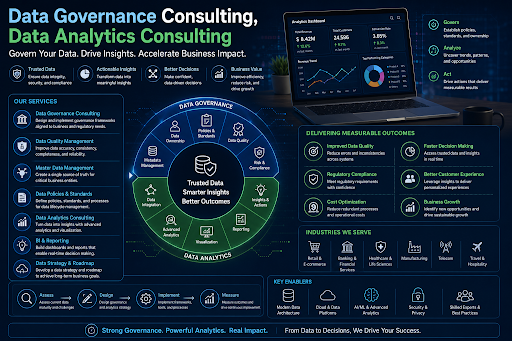
Every enterprise wants better analytics, but few stop to ask whether their underlying data can actually be trusted. This is the blind spot data governance consulting is designed to fix. Without clean, well-governed data, even the most sophisticated analytics investment produces misleading dashboards, questionable KPIs, and executive decisions built on quicksand.
Pairing data governance consulting with focused data analytics consulting ensures organizations build insight on a foundation solid enough to support real business decisions. Governance defines the rules of the road; analytics turns compliant, trustworthy data into commercial value. Neither succeeds sustainably without the other.
Why Analytics Initiatives Quietly Fail
Many analytics programs stall not because of weak tools, but because of weak data foundations — duplicate records, inconsistent definitions across departments, unclear ownership over data quality, and no shared understanding of what specific metrics actually mean. When finance says revenue is one number and sales says it is another, no dashboard will save the conversation.
Data governance consulting addresses this at the root. It establishes clear policies, data stewardship roles, quality standards, and metadata practices before analytics teams start building dashboards on shaky ground. Good governance is invisible when it works, but its absence is felt every time a report is questioned.
Defining a Single Source of Truth
When sales, finance, and operations each maintain their own version of key metrics, analytics becomes an exercise in reconciling numbers rather than generating insight. Governance consulting establishes canonical definitions everyone works from, ending the endless debates over whose spreadsheet is correct.
Metadata and Lineage as Trust Signals
Understanding where a data point originated and how it was transformed builds the confidence executives need to actually act on analytics output. Without lineage, every insight becomes a guessing game. With it, dashboards move from suggestion to instruction.
Where Data Analytics Consulting Takes Over
Once governance establishes trustworthy data, data analytics consulting turns that foundation into actionable insight. This includes building the right models, dashboards, and predictive capabilities aligned to specific business questions rather than generic reporting that nobody opens twice. Great analytics consulting starts with outcomes, not tools.
The best data analytics consulting engagements begin with a business question: what decision needs to be made better, what behavior needs to change, or what opportunity needs to be captured. Analytics is then designed backward from that answer, ensuring every dashboard, model, and alert connects to something the business actually cares about.
- Data quality scorecards tied to specific governance policies and business impact
- Role-based data access aligned with compliance and privacy requirements
- Self-service analytics enabled without sacrificing governance controls or auditability
- Predictive models validated against governed, trusted datasets before production deployment
- Executive dashboards that answer specific strategic questions rather than displaying every metric
- Continuous adoption programs so analytics investment translates into daily operating habits
Preparing the Data Foundation for AI
AI and machine learning models are only as good as the data they learn from, which puts a brighter spotlight than ever on data governance. Biased, incomplete, or poorly labeled training data leads to models that are confidently wrong at scale — and unlike a bad dashboard, a bad model can affect thousands of automated decisions before anyone catches the problem.
This is why forward-looking enterprises now think about data governance consulting as AI readiness work. Clear lineage, well-defined data quality metrics, and controlled feature stores are the difference between AI programs that deliver measurable business value and ones that produce impressive demos but fail in production. Data analytics consulting increasingly extends into MLOps, ensuring the same governance principles that apply to dashboards also apply to models running quietly in the background of critical business processes.
Governance and Analytics as a Continuous Partnership
Governance and analytics are not sequential, one-time projects — they need to operate as an ongoing partnership. As new data sources are added, business questions evolve, and regulations change, governance policies must adapt just as quickly as the analytics built on top of them. Treating either as static is how enterprises end up with policy documents nobody follows and dashboards nobody trusts.
Enterprises that treat these two disciplines as permanently linked, rather than siloed initiatives, consistently produce more reliable, faster, and more trusted business intelligence. The right combination of data governance consulting and data analytics consulting turns data from an operational byproduct into a genuine strategic asset that leadership can lean on with confidence.
Common Pitfalls in Governance and Analytics Programs
Governance and analytics initiatives share a set of predictable failure modes. Anticipating these pitfalls up front lets leaders design programs that avoid the most common causes of stalled progress.
- Launching data analytics consulting engagements before governance foundations exist to support them
- Assigning data ownership only within IT rather than embedding stewards in each business domain
- Treating data governance consulting as a documentation exercise instead of an operating discipline
- Building dashboards nobody has been trained to interpret, then wondering why adoption is low
- Ignoring data lineage so no one can explain how a specific metric was actually calculated
- Underestimating the ongoing effort required to keep policies current as the business evolves
Actionable Insights for Enterprise Leaders
- Establish clear data ownership and stewardship roles before launching new analytics initiatives across the business
- Build a canonical glossary of key business metrics shared across all departments and refreshed quarterly
- Track data lineage so every analytics output can be traced back to its source and transformation history
- Revisit governance policies whenever new data sources, systems, or regulatory obligations are introduced
- Invest in adoption and training programs so analytics tools become part of daily operating routines
- Use data governance consulting engagements as the foundation for AI and machine learning readiness
Conclusion
Trustworthy analytics starts long before a dashboard is built — it starts with governance. Enterprises that invest in data governance consulting alongside data analytics consulting create a virtuous cycle: clean, well-managed data feeds reliable insight, and that insight in turn reinforces the discipline needed to keep data governed well. In a data-driven economy, this combination is what separates organizations that make confident decisions from those still arguing over whose numbers are right.